Buy acnibo.eu ?
We are moving the project
acnibo.eu .
Are you interested in purchasing the domain
acnibo.eu ?
domain@kv-gmbh.de · 0541-91531010
Buy acnibo.eu ?
How do you convert mass percent to volume percent?
To convert mass percent to volume percent, you first need to know the density of the substance. Then, you can use the formula: volume percent = (mass percent / density) * 100. This formula takes into account the relationship between mass, volume, and density to accurately convert the percentage from mass to volume. **
Would I prefer 5 percent inflation to 5 percent unemployment?
The preference between 5 percent inflation and 5 percent unemployment would depend on individual circumstances and priorities. Generally, moderate inflation can be manageable and even beneficial for economic growth, as it encourages spending and investment. On the other hand, high unemployment can lead to financial instability and social issues. Therefore, some individuals may prefer 5 percent inflation over 5 percent unemployment if they prioritize economic stability and growth. **

Similar search terms for Percent
Top-Angebote
Products related to Percent:


-
Is around half 48 percent or 52 percent or both?
Around half is typically considered to be 50 percent, as it is exactly halfway between 0 percent and 100 percent. However, in some contexts, around half could be approximated as 48 percent or 52 percent, as they are close to the halfway point. Ultimately, the exact percentage considered to be around half may vary depending on the specific situation or preference for rounding. **
-
Is the content specified in volume percent or weight percent?
The content specified is in volume percent. This means that the percentage is calculated based on the volume of the substance in relation to the total volume of the mixture. This is commonly used in industries such as the oil and gas industry, where the volume percent of certain components in a mixture is important for various processes and calculations. **
-
Why do 80 percent of women prefer 20 percent of men?
The concept that 80 percent of women prefer 20 percent of men is often associated with the Pareto Principle or the 80/20 rule. This principle suggests that a small percentage of men possess qualities or characteristics that are highly desirable to the majority of women. These men may exhibit traits such as confidence, ambition, charisma, or physical attractiveness that make them stand out among the rest. Additionally, societal norms and media influence may also play a role in shaping women's preferences towards a select group of men. **
-
Percentage points or percent?
When discussing changes in percentages, it is more accurate to use "percentage points" rather than "percent." This is because "percentage points" refer to the actual change in percentage, while "percent" simply refers to the proportion or rate itself. For example, if a company's market share increases from 20% to 25%, the change is 5 percentage points, not 5 percent. Using "percentage points" helps to avoid confusion and provides a clearer understanding of the actual change in percentage. **


What are 54 percent?
54 percent is a way of expressing a portion of something as a fraction of 100. It means 54 out of every 100 parts. In other words, if something is 54 percent, it represents more than half of the whole. **
What are 38 percent?
38 percent is a way of expressing a portion of a whole as a fraction of 100. It represents 38 parts out of 100, or 38/100. In other words, if something is 38 percent, it means that 38 out of every 100 units are of that particular thing. It is commonly used to describe proportions, percentages, and rates in various contexts such as finance, statistics, and everyday life. **
Top-Angebote
Products related to Percent:
-
Cornerstone Press Make Me Well: The Truth About the Wellness Industry, Supplements, and Personalised Health by Xand van TullekenIn a world of endless wellness advice, learn how to make smarter decisions about your health with the empowering new book from doctor and broadcaster Xand Van Tulleken. Drawing on original reporting, expert insight and real-world case studies, he explores: The truth about supplements and vitamins ― what works and what doesn’t The rise of at-home blood testing and personalised health plans How wearable technology (fitness trackers, sleep trackers, smartwatches) shapes our behaviour The promises and pitfalls of consumer genomics and DNA testing Why the line between healthcare and the wellness industry has become blurred There has never been a more confusing time to try to be healthy. From supplements and blood testing to wearable technology and consumer genomics, the modern wellness industry promises better energy, performance and longevity. But how much of it is science, and how much is marketing? In his groundbreaking book, Make Me Well, Xand van Tulleken investigates the new Wild West of the wellness industry, offering a clear, evidence-based guide to navigating today’s most popular health trends. With practical advice and accessible science, Make Me Well will help you cut through misinformation, avoid unnecessary costs, and make informed decisions about your physical and mental wellbeing. If you’ve ever wondered which health trends are worth your time and money, this is your essential guide to modern wellness.12,99 £*Shipping: 2,99 £Secure redirect to the provider
-
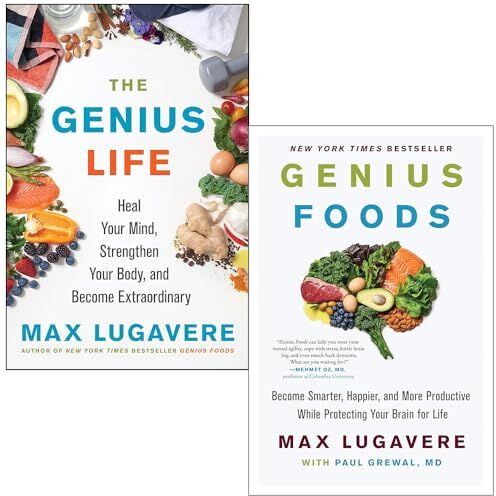
Harper ltd Max Lugavere 2 Book Set – Genius Foods & The Genius Life Brain Health, Nutrition & Wellness CollectionMax Lugavere 2-Book Collection Set (The Genius Life & Genius Foods – Nutrition, Health, Wellness, Diet, Brain & Body Health, Self-Help & Fitness) The Genius Life: Heal Your Mind, Strengthen Your Body, and Become Extraordinary: Supporting the work of Battersea Dogs and Cats Home.Enjoy a heartwarming dog to brighten every single day of the year. From Pickles, the dog who single-handedly saved the 1966 world cup, to Pal, who found silver screen fame as the original Lassie, Battersea's A Dog a Day contains 365 fascinating stories of dogs to enjoy throughout the year.Beautifully packaged and illustrated throughout with charming illustrations of cheeky puppies and hounds, this is the perfect book for any lover of our four-legged friends. Genius Foods: Become Smarter, Happier, and More Productive While Protecting Your Brain for Life: After his mother was diagnosed with a mysterious form of dementia, Max Lugavere put his successful media career on hold to learn everything he could about brain health and performance. For the better half of a decade, he consumed the most up-to-date scientific research, talked to dozens of leading scientists and clinicians around the world, and visited the country’s best neurology departments—all in the hopes of understanding his mother’s condition.Now, in Genius Foods, Lugavere presents a comprehensive guide to brain optimization. He uncovers the stunning link between our dietary and lifestyle choices and our brain functions, revealing how the foods you eat directly affect your ability to focus, learn, remember, create, analyze new ideas, and maintain a balanced mood.12,95 £*Shipping: 2,99 £Secure redirect to the provider
-
How do you convert mass percent to volume percent?
To convert mass percent to volume percent, you first need to know the density of the substance. Then, you can use the formula: volume percent = (mass percent / density) * 100. This formula takes into account the relationship between mass, volume, and density to accurately convert the percentage from mass to volume. **
-
Would I prefer 5 percent inflation to 5 percent unemployment?
The preference between 5 percent inflation and 5 percent unemployment would depend on individual circumstances and priorities. Generally, moderate inflation can be manageable and even beneficial for economic growth, as it encourages spending and investment. On the other hand, high unemployment can lead to financial instability and social issues. Therefore, some individuals may prefer 5 percent inflation over 5 percent unemployment if they prioritize economic stability and growth. **
-
Is around half 48 percent or 52 percent or both?
Around half is typically considered to be 50 percent, as it is exactly halfway between 0 percent and 100 percent. However, in some contexts, around half could be approximated as 48 percent or 52 percent, as they are close to the halfway point. Ultimately, the exact percentage considered to be around half may vary depending on the specific situation or preference for rounding. **
-
Is the content specified in volume percent or weight percent?
The content specified is in volume percent. This means that the percentage is calculated based on the volume of the substance in relation to the total volume of the mixture. This is commonly used in industries such as the oil and gas industry, where the volume percent of certain components in a mixture is important for various processes and calculations. **
Similar search terms for Percent
-
Why do 80 percent of women prefer 20 percent of men?
The concept that 80 percent of women prefer 20 percent of men is often associated with the Pareto Principle or the 80/20 rule. This principle suggests that a small percentage of men possess qualities or characteristics that are highly desirable to the majority of women. These men may exhibit traits such as confidence, ambition, charisma, or physical attractiveness that make them stand out among the rest. Additionally, societal norms and media influence may also play a role in shaping women's preferences towards a select group of men. **
-
Percentage points or percent?
When discussing changes in percentages, it is more accurate to use "percentage points" rather than "percent." This is because "percentage points" refer to the actual change in percentage, while "percent" simply refers to the proportion or rate itself. For example, if a company's market share increases from 20% to 25%, the change is 5 percentage points, not 5 percent. Using "percentage points" helps to avoid confusion and provides a clearer understanding of the actual change in percentage. **
-
What are 54 percent?
54 percent is a way of expressing a portion of something as a fraction of 100. It means 54 out of every 100 parts. In other words, if something is 54 percent, it represents more than half of the whole. **
-
What are 38 percent?
38 percent is a way of expressing a portion of a whole as a fraction of 100. It represents 38 parts out of 100, or 38/100. In other words, if something is 38 percent, it means that 38 out of every 100 units are of that particular thing. It is commonly used to describe proportions, percentages, and rates in various contexts such as finance, statistics, and everyday life. **
* All prices are inclusive of VAT and, if applicable, plus shipping costs. The offer information is based on the details provided by the respective shop and is updated through automated processes. Real-time updates do not occur, so deviations can occur in individual cases. ** Note: Parts of this content were created by AI.